


Renovating Responsibly: A Balancing Act
Although Drumearn House has been standing for 170 years, it’s spent the last 20 to 30 years simply surviving. Now, as custodians of the house and estate, it’s our role to bring life and beauty back into the building and give it a meaningful future.
Caring custodianship of Drumearn House is all about making the right decisions for this building. As a listed building, we must repair it using materials and methods that respect its original fabric and honour the techniques and care that went into its original construction wherever possible. Here’s a little more about some of the principles that have guided this stage of the build.
Preserve as much as possible
From the outset, we've been guided by long-term thinking and care rather than speed or convenience. Demolition and a rebuild would have been significantly cheaper, simpler and quicker for this project, but Drumearn House was acquired with a clear intention: to protect the character, craftsmanship and spirit of the house that Peter Drummond built in 1856, and to pass it on in a condition worthy of generations to come. That’s why we’re keeping everything we can of the original property.
Honour original materials
Stonework needs to match the appearance of the original stones (although it doesn’t need to come from the original quarry). Similarly, the slates used on the roof were from the Aberuchill Quarry, which has been closed for many years. Midland slates are the closest match available, so we'll be using these as our best option.
Much of the repair and replacement work relies on specialist craftsmanship from traditional slating to cast-iron guttering and leadwork. Bringing in the right people will make sure these repairs are both sympathetic to the original house and stand the test of time.
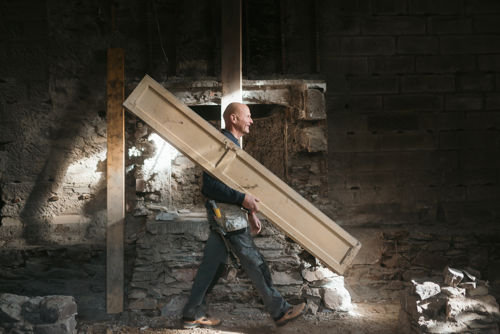
We’ve applied the same approach to timber. Originally, the timber used throughout Drumearn House came from older trees with tighter growth rings and stronger grain, which gave it better resistance to weather and insects. By contrast, a lot of today’s timber is harvested younger, although treatment processes make sure it lasts just as long. That’s why we’re retaining as much of the original timber as is structurally sound and salvageable.
Always use our best judgement
The windows have presented a lot of complex challenges. In some locations, we can preserve the original glass. This is especially relevant on the west elevation, where several beautiful, curved panes remain that we’re hoping to save.
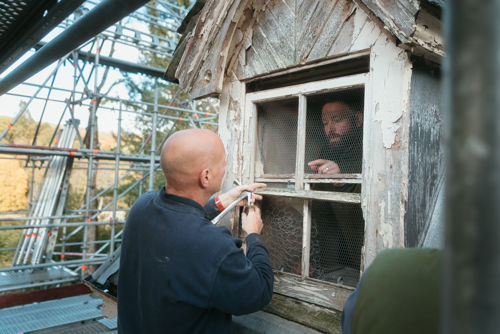
However, their frames have largely deteriorated due to dry rot. Here, restoration becomes a matter of good judgement: how much can responsibly be retained, and where does replacement better serve the building’s long-term performance? Often, this comes down to careful, case-by-case calls.
There will continue to be trade-offs, compromises and challenges at every stage of our renovation journey – but we’re confident that every decision is made with the best interest of this magnificent building at heart.


