


Things are looking up: Breathing fresh life into the Drumearn cornicing
In almost every room of Drumearn House, there are the remains of once magnificent decorative cornicing that dates to the mid-19th century when the house was first constructed, and the 1870s when the extension was added. But years of water ingress and devastating damage from rot have all but destroyed it. Our challenge now is bringing it back to life.
Our worse-for-wear walls
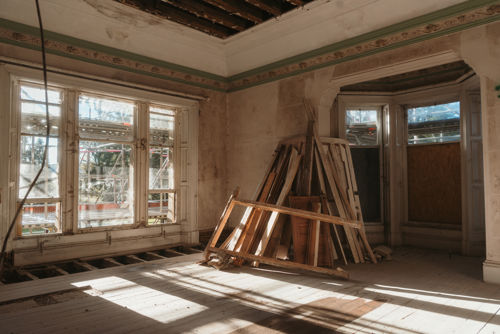
When we first acquired Drumearn House, it was clear that its condition was worse than anyone might have guessed. The building looked sound enough from the outside – after all, the roof hadn’t collapsed and there weren’t any trees growing through the windows. You could be forgiven for thinking the house had simply been sitting drying out and was well preserved. We soon discovered this was far from the truth…
Most of the lead ridging was stolen years ago, and with gutters blocked and downpipes filled with debris, water had seeped into the stonework, the timber, and everything in between. This created ideal conditions for both dry rot and wet rot and didn’t bode well for the cornicing!
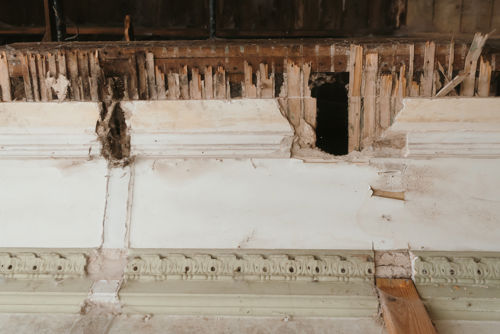
The way the walls, cornicing, and ceilings were originally constructed - using plaster and timber - has left these areas in a poor state, with walls and beautiful, original detail crumbling away. This is especially pronounced in the West elevation and 1870 extension, where ridging had been stolen and the Scottish weather had crept in.
Preserving our patterns
We were determined to retain what there was. Some rooms feature incredible historic designs, like egg and grape patterns. Others, particularly in the 1870s extension, have intricate detailing with gold finishes and a distinct wow factor. Each had its own distinct cornice pattern.
Before we even started the task of replacing the cornicing, we carefully documented the condition of the different styles throughout the house, including getting drone footage of hard-to-reach spots.
Replicating the originals
There are several ways to reinstate the rotten cornices. They can be recreated in the traditional manner using sectional plaster moulds, or, more cost-effectively, formed in fibreglass or, in some cases, high-density foam that can be plastered over or painted.
These recreations are typically made to a very high standard and often impossible to spot – in rooms with very high ceilings, the difference in finish is often unnoticeable. Mattias has visited historic mansions where these methods were used to convincing effect.
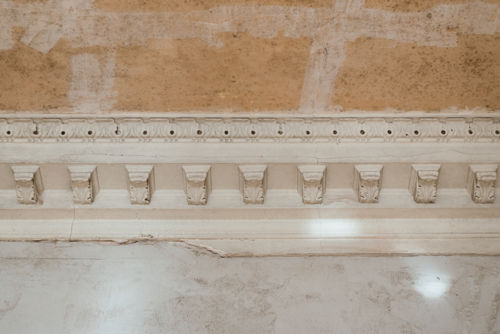
Assuredly, the cornicing is an integral part of the building, and it’s something we’re determined to preserve in one form or another. Unfortunately, much of the timber behind the existing cornices appears to be affected by dry rot, meaning the timber and cornice will have to be carefully removed and replaced with new material.
Our focus will be on retaining everything we can and caringly reproducing everything that can’t be salvaged. Watch this space for more updates on the Drumearn House interiors!


